

Risk Management · 2025
In this section3 topics
Risk Management Policy & Plan
Policy & Plan Description
Amata Group recognizes the importance of effective risk management, which serves as a fundamental factor in enabling the Company to execute its strategic plan and achieve the business objectives. The Company therefore places importance on identifying, assessing and managing risks and opportunities that may impact business operations, financial position and performance in the short, medium and long term. In addition to risks directly related to business operations, the Company also places significant emphasis on Sustainability-related Risks and Opportunities, covering environmental, social and governance issues, which may impact the Company's operations across the entire value chain, including its ability to achieve business objectives and sustainable organizational growth.
The Company has established a "Risk Management Policy" by adopting the Committee of Sponsoring Organizations of the Treadway Commission (COSO) frameworks, both COSO ERM 2017 (Enterprise Risk Management - Integrating with Strategy and Performance) and COSO ESG 2018 (Enterprise Risk Management - Applying ERM to Environmental, Social, and Governance-related Risks). These frameworks serve as the foundation for across enterprise risk management, tailored to fit the Company’s operations. The Company designates risk management as a shared responsibility of the Board of Directors, executives, and all relevant departments at every level, integrating the risk management process as part of strategic decision-making, work planning and business operations, to strengthen the Company's ability to handle uncertainty, reduce the impact of risks and support the achievement of objectives efficiently.
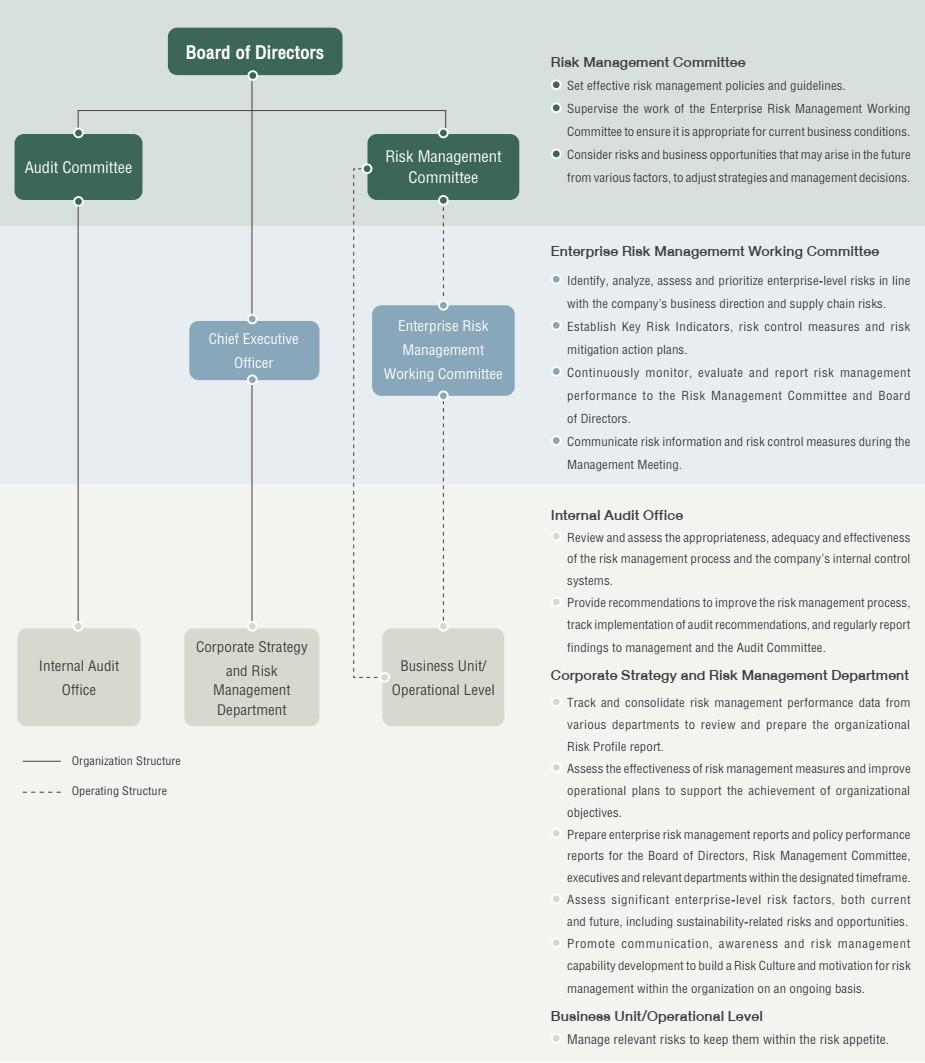
To comply with Good Corporate Governance (GCG) principles, the Company has established the following risk management structure:
1. Risk Management Committee (RMC)
The Board of Directors has assigned the Risk Management Committee (RMC) to oversee the effectiveness and efficiency of risk management. The committee consists of 2 Independent Directors, 2 Executive Directors and 4 Senior Executives, totaling 8 members, with an Independent Director serving as Chairman of the RMC, supporting governance oversight. The RMC’s key responsibilities include 1) establishing risk management policies and guidelines, 2) supervising the Enterprise Risk Management Working Committee (ERMWC) and 3) monitoring existing risks and evaluating emerging risks arising from economic conditions, business competition, technological and social factors, legal and regulatory changes and transition risks that may impact future business operations. Additionally, the RMC identifies business opportunities arising from risks, providing strategic recommendations for the Company to adjust its business strategies accordingly.
2. Enterprise Risk Management Working Committee (ERMWC)
To ensure that the Company's risk management covers operations at all levels of the organization and is effective, in accordance with the Risk Management Policy, the company has established the Enterprise Risk Management Working Committee (ERMWC), composed of executives & representatives from each business units and support functions, Managing Directors of subsidiaries, totaling 24 members, chaired by the Chief Financial Officer (CFO).
The Enterprise Risk Management Working Committee (ERMWC) is responsible for identifying, analyzing, assessing, and prioritizing risks across the Company. This includes establishing Key Risk Indicators (KRIs), defining risk control measures and developing risk mitigation action plans. The committee regularly reports on risk management performance, particularly key risks, to the Risk Management Committee (RMC) and the Board of Directors on a quarterly basis. Additionally, risk-related information and control measures are communicated at least twice a year during the Management Meeting, chaired by the Chief Executive Officer (CEO).
3. Corporate Strategy & Risk Management Department
The Corporate Strategy and Risk Management Department supports risk owners in their risk management activities including tracking and consolidating risk performance data to review the Risk Profile and assess the effectiveness of risk management, adjusting risk management plans to align with changing business environments, the organization's strategic direction, regulatory requirements, emerging risks, as well as risk signals or trends that may impact the achievement of organizational objectives.
The Department prepares enterprise risk management reports and policy performance reports for submission to the Board of Directors, Risk Management Committee, executives, and relevant departments within the designated timeframe. Additionally, to ensure risk management disclosures comply with regulatory requirements. Furthermore, the Corporate Strategy and Risk Management is responsible for conducting comprehensive assessments of current and emerging enterprise risks. The division covers strategic risks, operational risks, financial risks, as well as sustainability-related risks and opportunities, while communicating and building awareness, understanding, developing skills and building a Risk Culture within the organization, including fostering motivation in risk management among employees on an ongoing basis.
4. Internal Audit Office
The Internal Audit Office is responsible for reviewing and assessing the appropriateness, adequacy and effectiveness of the risk management process and the Company's internal control systems, to ensure that the Company's risk management operations are effective and consistent with established policies and guidelines. In addition, the Internal Audit Office provides recommendations to improve the risk management process, tracks the implementation of audit recommendations, and regularly reports audit findings to management and the Audit Committee.
Risks to the Company's Business Operations
Introduction
The Company conducts enterprise risk identification and assessment, covering 100% of all business units, in accordance with the COSO ERM and COSO ESG frameworks. This assessment considers business at the organizational level, business unit level and across the entire value chain, including Sustainability-related Risks and Opportunities, covering environmental, social and governance issues that may impact the achievement of the Company's objectives, strategies and goals.
In assessing risks, the Company applies a variety of strategic analysis and risk management tools, such as PESTEL Analysis, McKinsey 7S Framework and Scenario Analysis, and establishes Key Risk Indicators (KRIs) to monitor risk status and assess the effectiveness of risk management measures on an ongoing basis.
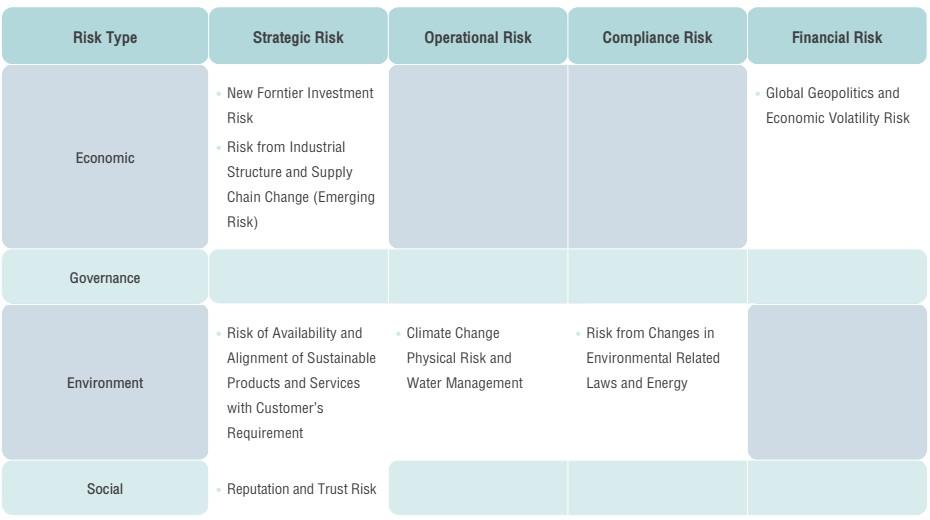
In 2025, the Company has identified the following significant enterprise-level risks that may impact the business operations:
Risk Register
| Risk Name | Risk Characteristics | Consequences | Management Measures | Related Risk Factors |
|---|---|---|---|---|
| New Frontier Investment Risk | The Company has expanded its investment in developing industrial estates in foreign countries, namely Vietnam, Laos and Myanmar, to support continuous long-term business growth and meet the demands of investors interested in the Southeast Asian region, particularly within the CLMVT countries (ASEAN countries in the Mekong River region). Currently, the Company has invested in two projects in Northern Vietnam (AMATA City Halong JSC and AMATA City Phu Tho JSC) and five projects in Southern Vietnam (AMATA City Bien Hoa JSC, AMATA Township Long Thanh Co., Ltd. and AMATA Service City Long Thanh 1&2 Co., Ltd.), and two projects in Laos (AMATA Smart & Eco City Natuey and AMATA Smart & Eco City Namor), which are currently under construction. The project in Myanmar (Yangon Amata Smart and Eco City) is currently under investment plan suspension. Such foreign investments are exposed to risks from both macro-level and country-specific factors. At the macro level, global economic volatility, geopolitical tensions, uncertainty in international trade policies and FDI trends may affect supply chain continuity and business confidence. At the country-specific level, differences in laws and regulations, investment promotion policies, environmental and social measures, political stability, banking regulations and exchange rate fluctuations are all factors that may affect the timeline, cost and economic viability of project development. | These risks may significantly impact the Company's revenue and operating costs, cause project development delays, increased construction costs or financial expenses, as well as affecting cash flow and return on investment. Furthermore, they may also affect corporate reputation, investor confidence and the Company's long-term competitiveness. |
| 728 · Description: Volatility in the industry in which the company operates · Info category: STRATEGIC_RISK · 730 · Description: Government policy · Info category: STRATEGIC_RISK · 731 · Description: Policies or international agreements related to business operations · Info category: STRATEGIC_RISK · 1715 · Description: Economic risk · Info category: STRATEGIC_RISK |
| Risk of Availability and Alignment of Sustainable Products and Services with Customer’s requirement | In 2025, 40% of the Company’s revenue was derived from recurring income, primarily from utility services, including water supply, wastewater treatment, electricity, natural gas, and industrial services, such as waste management services to over 1,386 manufacturing customers operating in Amata’s industrial estates in Thailand and more than In recent years, the trend of climate change policy and regulatory development has intensified both internationally and in Thailand, such as the European Union's Carbon Border Adjustment Mechanism (CBAM), as well as the growing trend of countries and business organizations worldwide announcing targets toward Carbon Neutrality and Net Zero Emissions. This has resulted in industrial operators needing to adapt to reducing greenhouse gas emissions and increasing resource efficiency in their business operations. These global trends have led to a significant shift in industrial requirement, with manufacturers in industrial estates increasingly requiring sustainable and environmentally friendly products and services. Over the past year, this demand has grown notably for solutions such as clean energy, low-carbon footprint utilities, energy-efficient buildings and factories, electrical mobility and transportation systems, efficient waste and resource management, and internationally certified eco-industrial estates. | If the Company is unable to develop and prepare sufficient, timely and competitive sustainable products, services and infrastructure, this risk may impact the long-term growth of recurring income from utility services, as well as the ability to attract new customers and retain existing ones, which may affect revenue from land sales and leasing, as well as the Company's overall performance and competitiveness. |
| 728 · Description: Volatility in the industry in which the company operates · Info category: STRATEGIC_RISK · 729 · Description: Behavior or needs of customers / consumers · Info category: STRATEGIC_RISK · 732 · Description: Changes in technologies · Info category: STRATEGIC_RISK · 1717 · Description: ESG risk · Info category: STRATEGIC_RISK · 1719 · Description: Climate change and disasters · Info category: STRATEGIC_RISK |
| Reputation and Trust Risk | The relationship and trust between the company and surrounding communities and stakeholders is an important Relationship Capital (Relationship Capital) critical to the continuity and sustainability of industrial estate development. In a context where society places increasing importance on responsible, transparent business that considers environmental and social impacts, maintaining the trust and confidence of stakeholders is a strategic factor for the company. If industrial estate development and operations are unable to appropriately manage environmental and community impacts, or lack effective stakeholder participation and communication processes, this may lead to distrust, conflicts and opposition from local residents. Issues of air quality, wastewater management, industrial waste, noise and health impacts are matters of concern for communities surrounding industrial estates. If the factual management information is not communicated transparently, it may create negative perceptions of the Company's operations. Furthermore, the widespread dissemination of information through social media today may rapidly and severely impact corporate reputation and image. For the Company, which has development projects in multiple countries including development and expansion in Thailand, the ability to operate continuously requires a Social License to Operate from communities and stakeholders in the area, which is the result of building good relationships, transparency and responsible impact management. | If the company loses community trust, it may impact business operations in multiple dimensions, such as increased costs for improving pollution control systems or environmental restoration, legal and regulatory risks from stricter scrutiny, delays in permit approvals or project expansion, as well as impacts on reputation in the eyes of investors, business partners and financial institutions, which may reduce the company's ability to access funding and increase financial costs. |
| 736 · Description: Damage to company image and reputation · Info category: STRATEGIC_RISK · 1717 · Description: ESG risk · Info category: STRATEGIC_RISK |
| Climate Change Physical Risk and Water Management | Climate change has become a structural risk factor directly affecting the stability of Thailand's water resources. Increasingly variable weather patterns, such as heavy rainfall over short periods, prolonged droughts and more frequent extreme weather events, are significantly increasing uncertainty around raw water sources and water infrastructure risks. For the Company, which operates industrial estates and utility systems, reliance on water resources is a fundamental factor in providing services to customers across all industrial sectors. Weather variability has reduced the accuracy of rainfall and reservoir level forecasts, and increased the risk of both flood crises and water shortages occurring within the same year, creating challenges for systematic water management. The Company's industrial estates in the Eastern region are located in a water-stressed area. Climate change further intensifies this risk across the short, medium and long term. In the event of prolonged drought, the Company may be unable to source sufficient raw water to meet customer needs, while abnormally heavy rainfall may damage drainage systems, water storage facilities and industrial estate infrastructure. This uncertainty creates challenges for systematic water management, including reserve planning, infrastructure investment, resource management and business continuity management. | These physical risks and water resource constraints may impact the continuity of utility services, increase costs from emergency raw water procurement or urgent infrastructure improvement investments, as well as restoration expenses. If customers in the industrial estate are forced to halt or slow production, this may affect the Company's service revenue, as well as long-term customer confidence and relationships, and may impact the Company's competitiveness in the long term. |
| 740 · Description: Shortage or fluctuation in pricing of raw materials or productive resources · Info category: OPERATIONAL_RISK · 750 · Description: Climate change and disasters · Info category: OPERATIONAL_RISK |
| Global Geopolitics and Economic Volatility Risk | The current global economic environment and geopolitical situation are highly volatile and uncertain, arising from factors such as international conflicts, trade tensions, changes in major economic powers' economic policies, inflation and global financial market volatility. These factors may cause greater volatility in financial markets and international capital flows, including impacts on interest rates, exchange rates and business access to funding. The Company has development projects both in Thailand and abroad, and utilizes financing from financial institutions and capital markets. Exchange rate and interest rate volatility may increase the Company's financial costs and increase uncertainty in financial management, particularly in the case of foreign currency borrowings or overseas investments, which may increase interest expenses and financial costs, and impact the Company's profitability and cash flow. Meanwhile, trade barriers, import tariff increases, rules of origin requirements and domestic industry support policies of trading partner countries may cause industrial estate operators to face higher costs or export restrictions, which may lead some companies to restructure their supply chains, reduce production capacity or consider relocating operations. These factors may affect Amata's ability to attract new investors, retain existing customers and develop future projects. | This situation may impact revenue from land sales and leasing, as well as utility service revenue, which represents the Company's recurring income. If new investment in industrial estates continues to slow, it may cause greater volatility in operating cash flow, and may affect new project development plans, as well as the Company's ability to generate revenue and return on investment in the medium to long term. |
| 761 · Description: Insufficient sources of funding · Info category: FINANCIAL_RISK · 762 · Description: Change in financial and investment policies of financial institutions that affect business operations · Info category: FINANCIAL_RISK · 764 · Description: Fluctuation in exchange rates, interest rates, or the inflation rate · Info category: FINANCIAL_RISK · 1724 · Description: Liquidity risk · Info category: FINANCIAL_RISK · 1725 · Description: Income volatility · Info category: FINANCIAL_RISK |
| Risk from Changes in Environmental-Related Laws and Energy | Changes in laws, regulations and policies related to the environment and energy, both domestically and internationally, are trending toward increased stringency and complexity, particularly requirements related to climate change, GHG emission regulations, carbon pricing and tax mechanisms, energy efficiency standards, renewable energy promotion, energy market structure regulation, as well as sustainability disclosure requirements transitioning from voluntary to mandatory in many countries. These changes reflect a regulatory direction aligned with international standards, global capital market expectations and stakeholders who place increasing importance on ESG. The uncertainty and dynamics of the above laws and policies may affect the Company's business model, cost structure, project development, energy procurement and use, as well as financial conditions and access to funding. If the Company is unable to adapt or comply with changing requirements in a timely manner, it may face Compliance Risk as well as strategic risk from Energy Transition Risk that may impact long-term competitiveness. | These risks may result in the Company facing higher operating and investment costs, the need to upgrade processes or infrastructure to comply with new requirements, potential fines or penalties from non-compliance, as well as impacts on reputation, investor confidence and stakeholder relationships, which may ultimately affect the Company's performance and long-term business sustainability. |
| 756 · Description: Change in laws and regulations · Info category: COMPLIANCE_RISK · 758 · Description: Violations of laws and regulations · Info category: COMPLIANCE_RISK |
| Risk from Industrial Structure and Supply Chain Change (Emerging Risk) | Based on the Company's risk assessment, one material emerging risk has been identified that may impact business operations over the next 3–5 years: the risk arising from structural transformation of the industry and supply chain. While this risk has not yet produced a material impact on the Company's financial performance, structural shifts in global industry, technology, energy, and supply chains are accelerating rapidly. Should this risk materialize at a heightened level, it could significantly affect customer demand patterns, revenue structure, and the Company's strategic investment direction. Accordingly, the Company has elevated this issue to an Enterprise Risk, requiring close monitoring, ongoing situation assessment, and periodic review of the risk exposure level. The Company has conducted in-depth data collection from operators across various industries in Amata industrial estates, both domestically and internationally, through structured interviews and continuous industry trend monitoring. This information has been used to support corporate strategy formulation and business development planning. The Company has identified that industry transition, technological disruption, and global supply chain realignment are key factors reshaping investment decisions among industrial estate operators. The transition from traditional industries toward those supporting a low-carbon economy, including the shift from internal combustion engine (ICE) vehicles to electric vehicles (EV), the adoption of clean energy, carbon emissions reduction, and the integration of automation and digitalization into manufacturing processes, is driving ongoing structural changes in supply chains and demand patterns. These insights have been incorporated into the Company's industrial estate development planning to ensure responsiveness to industry changes and alignment with future industry direction. At the same time, global supply chain restructuring driven by geopolitical dynamics, trade policies, and industrial development strategies of major economies and global industry leaders such as the United States, the People's Republic of China, Japan, and the European Union is influencing production base relocation, supply chain diversification, and capital investment flows into Southeast Asia. Countries including Thailand, Vietnam, and the Lao People's Democratic Republic are increasingly benefiting from this trend. The Company recognizes this opportunity and has continued strengthening infrastructure readiness, investment support systems, and internal operational frameworks to meet the evolving needs of next-generation investors. In addition, the expansion of advanced technology industries, including data centers, semiconductors, and advanced electronics, increases infrastructure complexity due to their high energy and water consumption. These developments are closely linked to climate-related risks. Transition risks arise from tightening carbon regulations and emissions reduction commitments across global value chains, while physical risks relate to climate variability that may affect the reliability of energy systems and water resources. These challenges also create sustainability readiness risks if infrastructure, clean energy availability, and ESG performance do not meet customer and investor expectations. | Such risks may increase operational costs and accelerate the need for investment in clean energy and greenhouse gas emissions reduction technologies. In response, the Company prioritizes the development and improvement of utility systems, clean energy infrastructure, and efficient water management, while also applying digital technologies to enhance resource efficiency and reduce emissions. These priorities are integrated into the Company's enterprise risk management framework and medium- to long-term strategic planning to strengthen competitiveness and support sustainable growth. |
| 728 · Description: Volatility in the industry in which the company operates · Info category: STRATEGIC_RISK · 729 · Description: Behavior or needs of customers / consumers · Info category: STRATEGIC_RISK · 732 · Description: Changes in technologies · Info category: STRATEGIC_RISK · 733 · Description: Business operations of partners in the supply chain · Info category: STRATEGIC_RISK |
Risks to Securities Holders' Investment
Risk Register
| Risk Name | Risk Characteristics | Consequences | Related Risk Factors |
|---|---|---|---|
| Credit Risk | Credit Risk refers to the risk that the issuer of securities may be unable to meet its debt obligations as scheduled, regardless of the type of debt. This may lead to higher financial costs and affect the Company's ability to repay its debts. Investors can review relevant investment information, including the Company’s financial performance, financial position, credit rating, corporate governance and ESG (Environmental, Social, and Governance) ratings. These details can be accessed from the Securities and Exchange Commission (SEC) website or reputable credit rating agencies. In | If credit risk were to materialize, it could lead to higher financial costs, reduced access to funding sources, or a downgrade in the Company’s credit rating. This may affect the Company’s ability to meet debt obligations, invest in business expansion, and maintain the confidence of investors and business partners in the long term. | 768 · Description: Return from investment of securities holder · Info category: HOLDER_RISK |
| Liquidity Risk | Liquidity Risk arises when the Company cannot convert its securities or assets into cash to meet short-term financial obligations, though it does not directly result in a loss of asset value. The Company has identified cash flow liquidity indicators as a Key Risk Indicator (KRI) that must be closely monitored. As of 2025, these indicators remain at a normal level, and the Company’s liquidity risk is assessed as moderate to low. | If liquidity risk were to occur, it could result in the Company being unable to settle debts or obligations when due, requiring reliance on short-term funding at higher costs, or necessitating the premature disposal of assets. This could affect financial stability, the confidence of creditors and investors, and the Company’s ability to continue operations and expand investments in the future. | 768 · Description: Return from investment of securities holder · Info category: HOLDER_RISK |