

MD&A · 2025
In this section4 topics
Overview of Operations
Overview of Operations
Economic and Industry Situation
In 2025, the global economy faced vulnerabilities from political factors, uncertainties in trade policy, and geopolitical tensions. However, it continued to grow supported by the policy rate cuts that helped stimulate consumption. The Organisation for Economic Co-operation and Development (OECD) projected global economic growth to 3.2% in 2025, reflecting resilience and adaptability of the economy. Major economies performed better than estimated (US 2.0%, China 5.0%, Eurozone 1.3%, Japan 1.3%). Despite this, global trade slowed after a surge in imports earlier, while inflation in some countries had yet to return to target and labor demand had also showed signs of weakening. The OECD expects global economic growth to slow to 2.9% in 2026 before picking up to 3.1% in 2027. Nonetheless, additional policy rate cuts are anticipated, and global labor markets are expected to ease, helping to reduce labor costs and inflationary pressures. Progress in international negotiations to reduce trade barriers would provide an additional boost to global economic growth while contributing to a moderation in inflationary pressures. Furthermore, following the US Supreme Court’s ruling on 20 February 2026, which invalidated the collection of reciprocal tariffs, a new import tariff rate was announced at 15% for all countries. This development may cause uncertainty and short-term volatility in global supply chains.
For Thailand’s economy in 2025 expanded by 2.4% marking an improvement from the previous year thanks to improvements in both domestic and external demand. External demand increased through higher exports, despite some periods of slowdown, while tourism revenue improved as tourist arrivals continued to recover. Domestic demand strengthened due to private consumption and investment, partly supported by government measures and higher government spending. Supply-side factors also improved, with the service sector expanding in line with trade and tourism activity, and industrial production began to rebound in December as factories resumed normal operations after maintenance shutdowns. In terms of economic stability, headline inflation remained negative due to lower fresh food prices, while core inflation stayed positive but slowed. Key issues to monitor include the impact of baht appreciation, tight business liquidity, the adaptability of industrial production, and the pace of tourism recovery.
For investment situation, the Thailand Board of Investment (BOI) reported record-high investment promotion applications in 2025, totaling 1,876,653 million baht—a 67% increase from the previous year—with 3,370 projects, up 11%. The top five industries by investment value were: Digital: Baht 746,198 million (151 projects), Electronics & Electrical Appliances: Baht 277,645 million (470 projects), Automotive & Parts: Baht 84,085 million (288 projects), Agriculture & Food Processing: Baht 75,683 million (301 projects), and Petrochemicals & Chemicals: Baht 58,396 million (267 projects) respectively. About 63% of the total projects were in Eastern Thailand. The total amount of Foreign Direct Investment (FDI) in 2025 was Baht 1,359,925 million, up 66% from the previous year. The top five sector by investment value were: Singapore: Baht 547,316 million, Hong Kong: Baht 245,335 million, China: Baht 172,114 million, Japan: Baht 119,098 million, and United Kingdom: Baht 100,322 million. The significant increase in investment from Singapore was mainly driven by large-scale projects whose parent companies are based in China, Japan, and the US.
Operating Results & Financial Condition
Operating Results & Profitability
Revenue Analysis
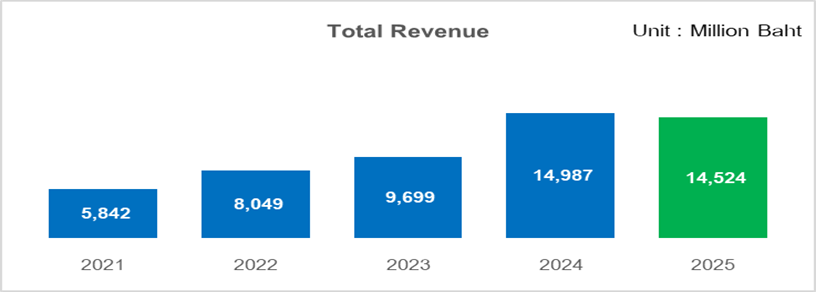
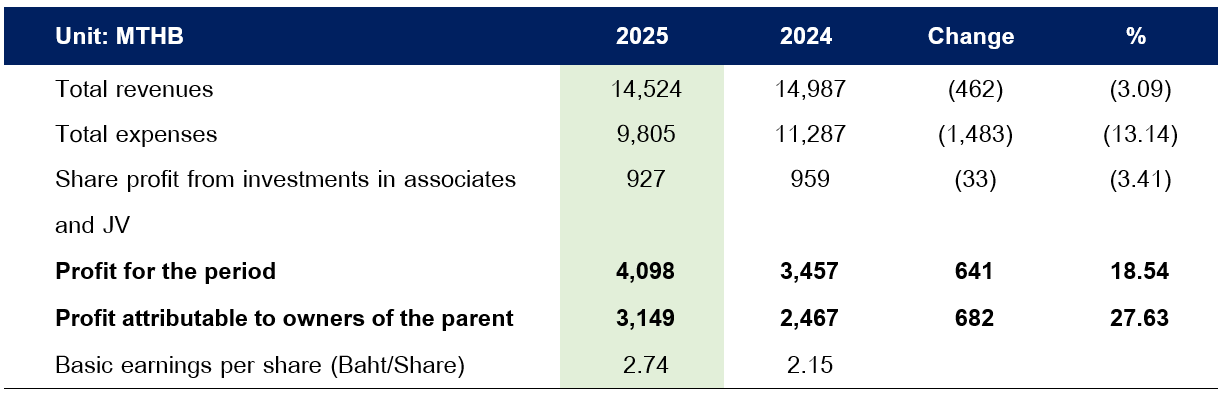
Amata Corporation Public Company Limited and its subsidiaries reported total revenues for the year 2025 at Baht 14,524 million, decreased by Baht 462 million or 3.09% from year 2024. The key factors are as follows:
Operating Performance Summary for the year ended 31 December 2025
2025’s performance versus 2024’s performance
|
Operating Performance Analysis of Core Businesses
Industrial Estate Development Business
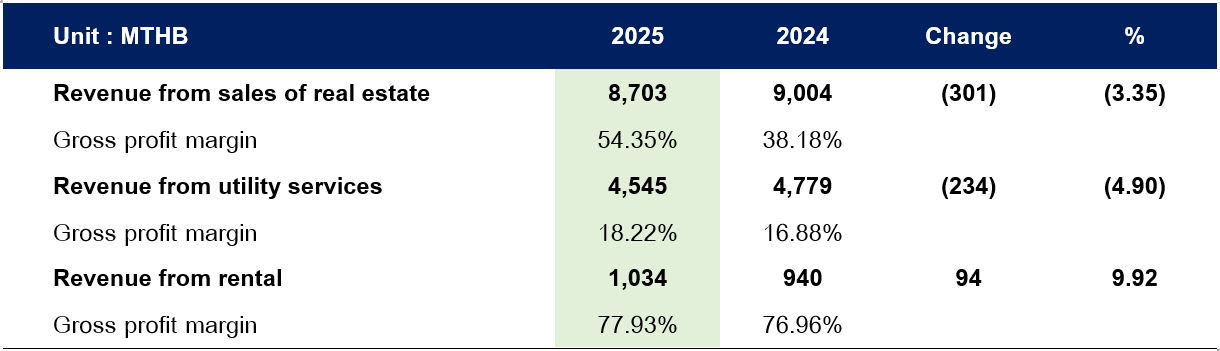
For the year 2025, AMATA reported revenue from sales of real estate at Baht 8,703 million, decreased Baht 301 million or 3.35% from 2024. The land transfer came from industrial estates in Chonburi, Rayong and Vietnam. In 2025, the company transferred land of 1,645 Rais (TH 1,493 Rais and VN 152 Rais) versus 1,912 Rais (TH 1,443 Rais and VN 469 Rais) last year. The gross profit margin (GPM) in 2025 was 54.35%, up from 38.18% in 2024 due to higher land transfers from Amata City Chonburi. In addition, GPM of the business in Vietnam has improved due to the development costs adjustments for land sold, excluding the 6-lane road from the previously calculation as the government will be responsible for constructing that road, which resulting to the development cost reduced by Baht 215 million. Without this adjustment, the GPM from real estate business in Vietnam still increased from the previous year.
Utility Services Business
Revenue from utility services business was Baht 4,545 million in 2025, decreased by Baht 234 million or 4.90% from last year, from the decrease in electricity usage of the customer in Vietnam due to the reduced production capacity. However, this contraction has shown signs of improvement in Q4/2025. The GPM increased to 18.22% in 2025 from 16.88% in 2024.
Rental Business
The Company reported a revenue from rental of Baht 1,034 million in 2025, which increased by Baht 94 million or 9.92% compared to 2024 due to the increase of leased areas. The GPM in 2025 was 77.93%, slightly increased from 76.96% in 2024.
Other Income

For the year 2025, the Company recognized finance income from financial institutions at Baht 95 million, increased 9.84% from last year. There is no gain on sales of investment properties in year 2025 compared to 2024 recorded at Baht 44 and other income at Baht 148 million, increased 11.57% from last year.
Expenses
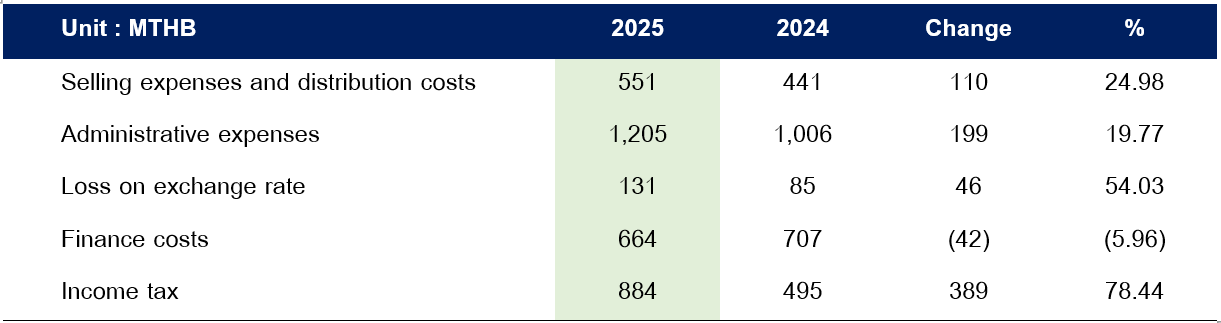
Selling expenses and distribution costs in 2025 were Baht 551 million, increased Baht 110 million or 24.98% compared to last year. Administrative expenses in 2025 were Baht 1,205 million, increased Baht 199 million or 19.77% compared to last year. Loss on exchange rate of Baht 131 million in 2025 compared to loss on exchange rate of Baht 85 million in 2024, the main reason is the depreciation of the Vietnamese Dong against the US Dollar, resulting in the larger recognition of exchange rate losses on the Group's US dollar-denominated loan. However, the Company has already implemented hedging measures and successfully refinanced its US dollar–denominated loan into Vietnamese dong in Q4/2025. Finance costs were at Baht 664 million in 2025, decreased Baht 42 million or 5.96% from 2024. The income tax expenses in 2025 were Baht 884 million, increased by Baht 389 million or 78.44% compared to last year based on increased operating profits. For Q2/2025, the Group disposed and recognized gain from the sale of shares in a subsidiary Baht 564 million, which is a related party transaction that appears in the separate financial statements amounted Baht 287 million, and resulted in the income tax increased in 2025 compared to 2024 because the income tax from the transaction was included in the consolidated financial statements in the amount of Baht 113 million, which is a non-recurring item. Excluding this item, the Company would have income tax expenses in the amount of Baht 771 million in 2025.
Share of Profit from Investments in Associates and Joint Ventures
The Company reported a share of profits from investments in associates and joint ventures in 2025 of Baht 927 million, decreased by Baht 33 million or 3.41% from last year, mainly attributed to the performance of power plants and natural gas distribution business, while the other business sectors recorded increases.
Net Profit
The net profit for the year 2025 reached Baht 4,098 million, increased by Baht 641 million or 18.54% from the year 2024, mainly driven by improved gross profit margins from core businesses especially for the real estate business. As a result, profit attributable to owners of the parent total THB 3,149 million or equivalent to basic earnings per share of THB 2.74.
Asset Management Capability
Financial Position Analysis
Assets
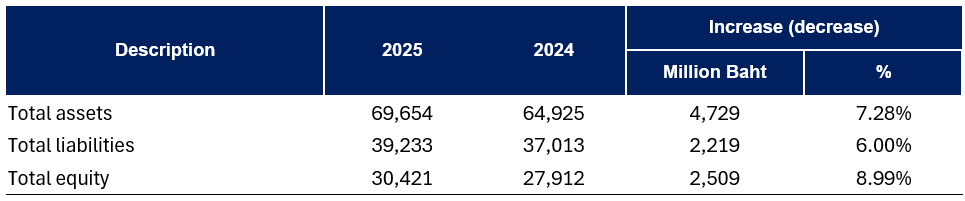
As of 31 December 2025, the Company had total assets of Baht 69,654 million, increased Baht 4,729 million or 7.28% from 31 December 2024, majority from current assets in terms of real estate development costs.
Liabilities
As of 31 December 2025, the Company had total liabilities of Baht 39,233 million increased Baht 2,219 million or 6.00% from 31 December 2024, mainly increased in loan from financial institutions for land acquisition.
Equity
As of 31 December 2025, the Company's shareholders' equity was Baht 30,421 million, increased Baht 2,509 million or 8.99% from 31 December 2024, following the increasing retained earnings.
Analysis of trade and other receivables
As of 31 December 2025, the Company and its subsidiaries had an outstanding trade and other receivables totaling to Baht 1,081 million, which comprised of trade and other receivables-related parties amounting to Baht 159 million, those of unrelated parties amounting to Baht 922 million, and less allowance for expected credit losses Baht 12 million. Therefore, total trade and other receivables are Baht 1,069 million.
Outstanding trade receivables from third parties and related parties can be analysed as follows:
Not yet due amounting to Baht 762 million.
Overdue up to 3 months amounting to Baht 35 million.
Overdue over 3 months but not over 6 months amounting to Baht 10 million.
Overdue over 6 months but not over 12 months amounting to Baht 18 million.
Overdue over 12 months amounting to Baht 7 million.
For the trade receivables-third parties as of the year ended 2025 totaling to Baht 823 million, the Company recorded an allowance for expected credit losses at Baht 8 million. Owing to a good policy and a protective measure on debt collection, the company had no bad debt arising from uncollectable accounts.
Analysis of Cash Flows
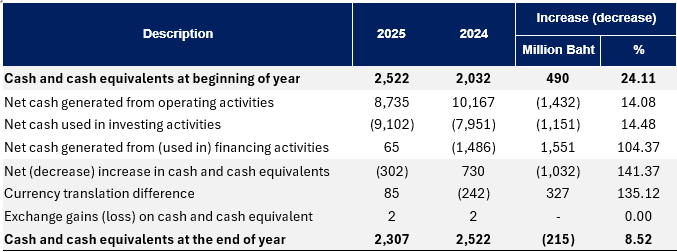
The cash flow from operating activities for the year 2025 amounted to Baht 8,735 million, most of them came from the deposits and advance received from customers in Thailand and Vietnam.
Cash outflows from investing activities for the year 2025 of Baht 9,102 million, the Company invested in land awaiting development and acquisition of investment properties.
Cash inflows from financing activities for the current year were Baht 65 million, Due to the net cash received from long-term loan from the financial institutions.
Debt Securities with Financial Ratio Requirements
Debt Securities with Financial Ratio Requirements Issued?
Yes
Can the Company Maintain the Reported Financial Ratios?
Yes
Explanation
Financial ratio analysis
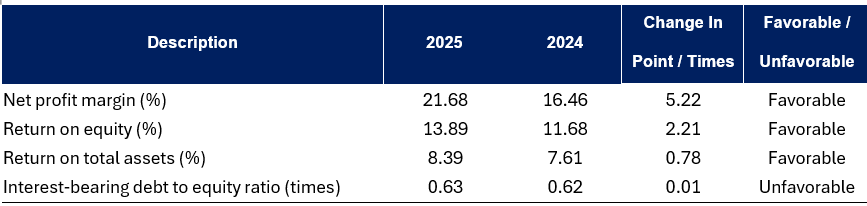
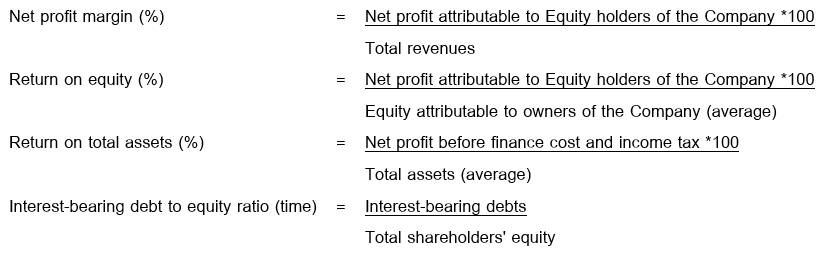
For the year 2025, the Company reported a net profit from operations of 4,098 million Baht, an increase of Baht 641 million or 18.54% compared to the year 2024. The increase in net profit was mainly due to the improved gross profit margin, especially in the industrial estate development business which attributing to an increase in selling prices as well as efficient management of costs in core businesses. As a result, net profit margin for 2025 is 21.68%, which increased from 16.46% in the year 2024.
The Company had a return on equity for the year 2025 at 13.89% and return on total assets at 8.39%, increased from the previous year because of the Company’s increase in net profit.
At year-end 2025, the interest-bearing debt to equity ratio was 0.63 times, slightly increased from 2024 which presented at 0.62 times due to the additional loan from financial institutions during the year to invested in land awaiting development. However, the company still maintained a relatively low ratio of interest-bearing debt to equity among its peers, representing a solid funding structure and flexibility.
Factors That May Affect Financial Condition
Factors or Incidents That May Materially Affect Financial Condition
Factors or events that may have significant impact on the Company’s financial performance or financial status
(forward looking)
The current global economic environment and geopolitical situation are highly volatile and uncertain, arising from factors such as international conflicts, trade tensions, changes in major economic powers' economic policies, inflation and global financial market volatility. These factors may cause greater volatility in financial markets and international capital flows, including impacts on interest rates, exchange rates and business access to funding.
The Company has development projects both in Thailand and abroad, and utilizes financing from financial institutions and capital markets. Exchange rate and interest rate volatility may increase the Company's financial costs and increase uncertainty in financial management, particularly in the case of foreign currency borrowings or overseas investments, which may increase interest expenses and financial costs, and impact the Company's profitability and cash flow.
Meanwhile, trade barriers, import tariff increases, rules of origin requirements and domestic industry support policies of trading partner countries may cause industrial estate operators to face higher costs or export restrictions, which may lead some companies to restructure their supply chains, reduce production capacity or consider relocating operations. These factors may affect Amata's ability to attract new investors, retain existing customers and develop future projects.
Uncertainty in the global economy and changes in international trade policies may cause FDI slowdown, or cause investors to delay investment decisions on new projects, particularly in industries linked to global supply chains such as automotive, electronics and advanced technology, which may reduce demand for land sales, factory leasing and utility services within industrial estates.
This situation may impact revenue from land sales and leasing, as well as utility service revenue, which represents the Company's recurring income. If new investment in industrial estates continues to slow, it may cause greater volatility in operating cash flow, and may affect new project development plans, as well as the Company's ability to generate revenue and return on investment in the medium to long term.
Risk Mitigation Measures
Prudently and systematically manage organizational liquidity, maintaining appropriate cash reserves and ability to access funding, to accommodate economic and financial market volatility and strengthen financial stability and business continuity.
Apply financial Scenario Analysis under diverse assumptions to assess the impact of interest rate, exchange rate and economic condition changes on cash flow, capital structure and the Company's investment capacity, as part of governing investment decisions, debt management and budgeting, to align with changing risk levels and economic conditions.
Enhance working capital and financial structure management alongside operational cost controls, reinforcing financial discipline and continuously monitoring key financial risk indicators, to maintain profitability, financial stability and the ability to adjust strategy appropriately under uncertain economic conditions.
Continuously monitor key financial risk indicators such as cash reserve levels, debt-to-equity ratio and interest payment capacity, to ensure the Company maintains an appropriate financial structure and can accommodate economic volatility.
As of 31 December 2025, the Company had a total debt-to-equity ratio of 1.29 times, with total liabilities amounting to THB 39,233 million. Meanwhile, interest-bearing debt amounted to THB 19,121 million (short-term and long-term bank borrowings of THB 17,871 million and debentures of THB 1,250 million). The long-term bank borrowings and debentures represented 25.08% of total assets, with cash, cash equivalents and short-term investments totaling THB 4,038 million.